Recalbox VR: the virtual reality headset dedicated to retrogaming
Wed Apr 01 2026
Recalbox VR: the virtual reality headset dedicated to retrogaming
Since its inception, Recalbox has pursued a simple mission: to make the gaming experience of the past both accessible and authentic. But over the years, one question has come up more and more often internally: how far can we push this experience?
Today, we’re ready to reveal an unexpected answer.
Here is Recalbox VR, our very first virtual reality headset dedicated to retrogaming.
A legacy dating back to the 90s
The idea of immersing players in their games is nothing new. As early as the mid-90s, the Virtual Boy was already attempting a radical approach to immersive 3D. Designed by Nintendo as a new way to play, the device offered stereoscopic display… entirely in red and black.
Ambitious, ahead of its time, yet limited by the technology of the era, the Virtual Boy remains a unique object today: a striking, imperfect, yet fascinating experiment.
This is exactly the kind of attempt that inspires us.
Recalbox VR: a natural evolution
Recalbox VR was born from a line of thinking that has been evolving for several years around immersion.
After working on timing accuracy, CRT display fidelity, and peripherals, one thing became clear: we wanted to go further.
The Recalbox VR headset was therefore designed as a logical extension of the Recalbox ecosystem. It’s not about transforming retro games into modern experiences, but rather enhancing them by stepping into the game and rediscovering it like never before.
The system relies on a high-definition stereoscopic display paired with a rendering engine specifically tailored for retrogaming. Every pixel, every scanline, every blur and persistence effect has been reworked to function in an immersive environment without betraying the original look.
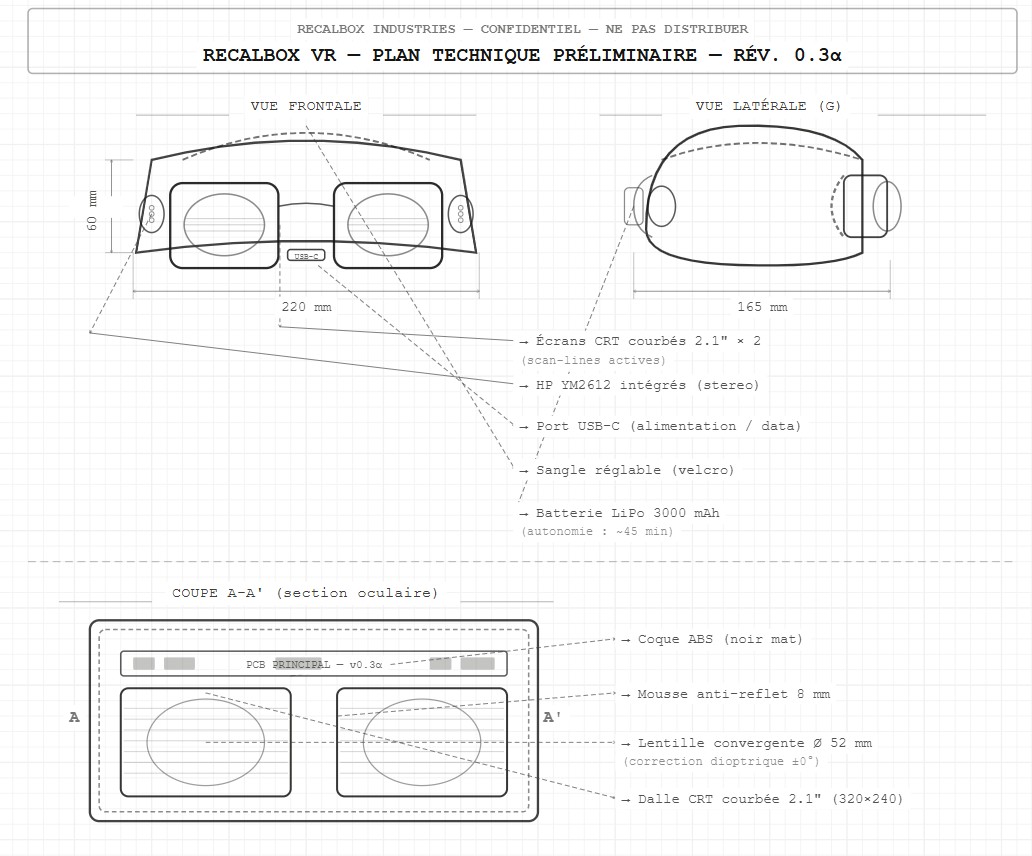
Early concepts
Unmatched sensations
One of the major challenges of the project was preserving the visual “readability” of retro games in a VR environment.
Unlike modern games, older graphics often rely on visual tricks tied to distance, display type, and sprite size. Translating that into a headset requires far more than a simple port.
“The hardest part wasn’t displaying games in VR, but recreating their original visual behavior. A scanline doesn’t have the same impact when shown on a flat screen versus perceived in depth. We had to completely rethink our image processing to achieve a proper result.”
— digitalLumberjack
“At first, we even considered integrating mini CRTs directly into the lenses to perfectly replicate the look of old displays — colors, scanlines, and all the charm of the era. But reality quickly caught up with us: the combined weight of the CRTs made the headset completely unmanageable. We had to rethink the concept entirely, keeping the visual fidelity and retro spirit, but with a much lighter and more comfortable solution… 7kg was just too heavy.”
— Bkg2k
A new way to play
Once in-game, it’s not so much the screen that surprises… but the way the games themselves subtly change in how they are perceived.
In a title like Metal Slug, depth becomes immediately noticeable. The different layers — background, gameplay area, foreground elements — are no longer simply stacked, they exist within a space. Explosions feel slightly detached from the scenery, projectiles move across the scene with clearer trajectories, and some animations gain impact simply because they occupy a “physical” position.
In Super Mario Bros., the effect is more subtle but just as interesting. Platforms appear slightly raised, enemies stand out more clearly from the background, and distances become almost instinctive. Without altering gameplay, this added depth brings a new clarity, as if the game reveals a structure that was always there but previously implicit.
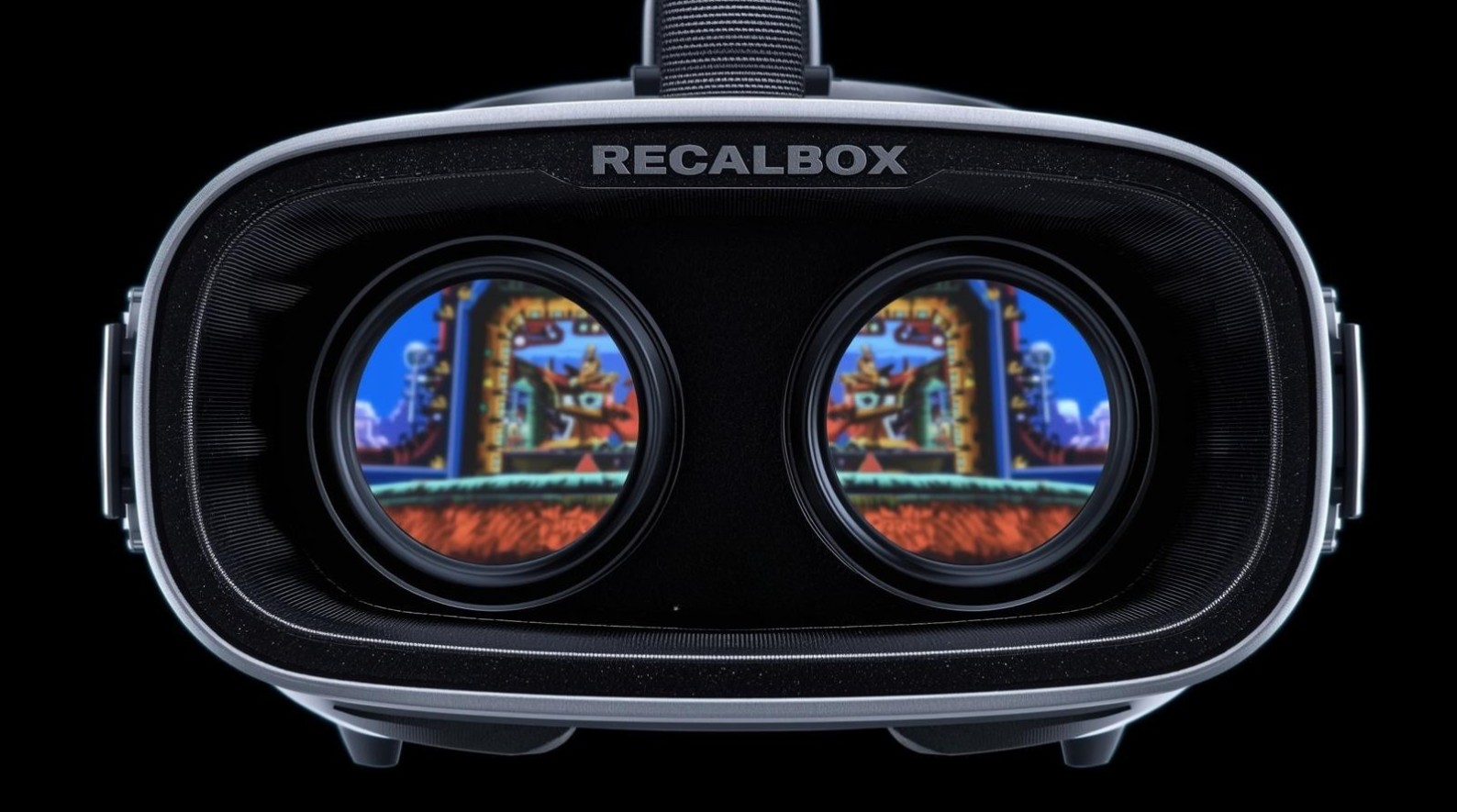
But it’s probably in a game like OutRun where the effect becomes most striking. The road no longer just scrolls by — it truly stretches into depth. Turns are easier to anticipate, elevation gives a sense of volume, and environmental elements — palm trees, signs, vehicles — sit within a far more tangible perspective. Where the game already relied on visual tricks to simulate 3D, VR enhances that illusion without betraying it.
What’s most striking is that nothing has been artificially added. This isn’t modern 3D layered on top of the games, but rather a spatial reinterpretation of their original elements. Sprites remain identical, proportions unchanged — only perception evolves.
And that’s precisely where the experience becomes uncanny: games you know by heart suddenly feel like they were always meant to be this way.
At the same time, special care has been given to the Recalbox environment. Rather than isolating the player in a neutral space, Recalbox VR places sessions back into familiar contexts through new VR-dedicated themes: a CRT television in a living room, an arcade cabinet, or a more minimal interface. Find the theme that suits you in the theme manager to browse your game library.
Technical details and availability
On the technical side, Recalbox VR features a dual micro-OLED display with a resolution of 3840 × 3840 pixels per eye, a refresh rate of up to 120 Hz, and latency below 10 ms.
Rendering is handled by a graphics pipeline optimized for stereoscopy, capable of recalculating CRT shaders and frame synchronization in real time while respecting the original refresh rates of emulated systems (50 Hz / 60 Hz). The goal is to ensure a stable, precise, and faithful image, even with the most demanding content.
The headset will be compatible with PC and Raspberry Pi 5 and is expected to launch by the end of the year. A FishStarter campaign will be launched to fund the project. And as a bonus, discover our two-player prototype:
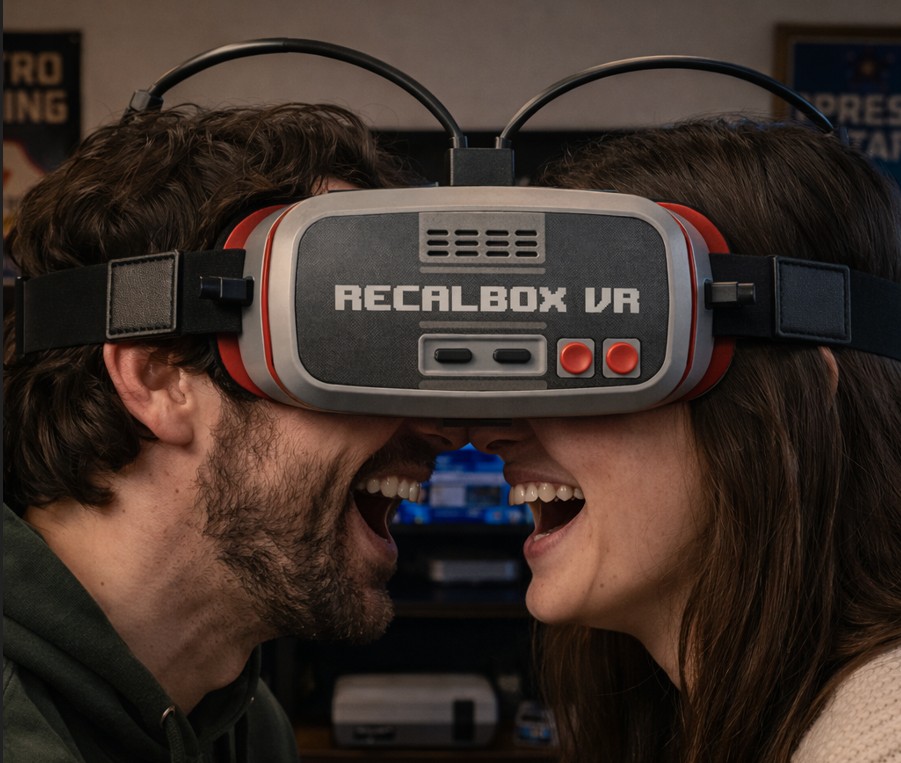
No AI was harmed in the making of these images.