2025 Retrospective: Recalbox Celebrates 10 Years
Tue Dec 23 2025
2025 Retrospective: Recalbox Celebrates 10 Years
2025 is coming to an end. For some, it’s time to look back on the past year, but for Recalbox, this one has been especially significant. And for good reason: Recalbox celebrated its 10th anniversary. Ten years marked by constant work on the upcoming V10, arriving very soon, but also by new hardware, a growing community, and an undiminished passion that allows us to replay the video games of our childhood.
In the world of retrogaming, Recalbox resonates with two key words: simplicity and accessibility. This free and open-source solution has transformed the way we relive our classics, making emulation accessible to everyone, from casual players to arcade experts. But what’s the story behind this true digital time machine?
Join us as we dive into a timeline that traces the spectacular evolution of Recalbox, from its humble beginnings on Raspberry Pi to its status as an ultra-complete retrogaming platform.
2015 — The foundations
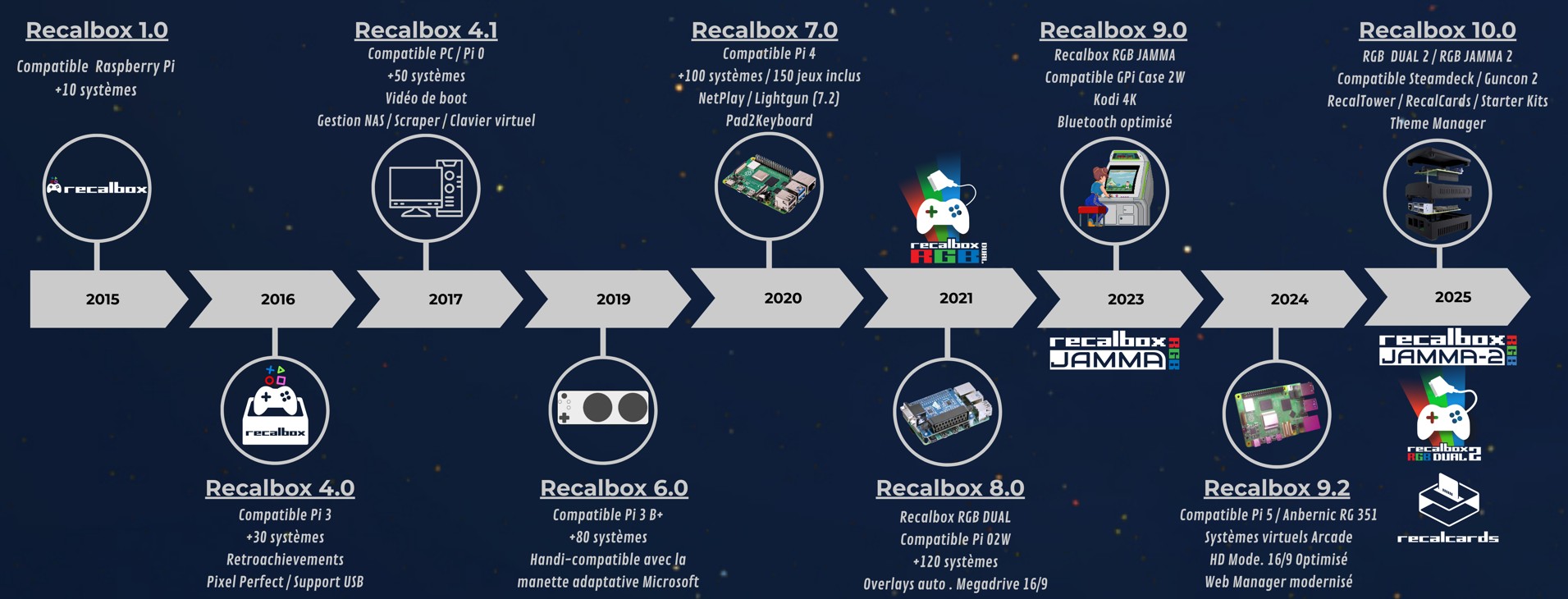
Launched in 2015, Recalbox 1.0 laid the foundations of an ambitious project: making emulation accessible to as many people as possible. Compatible with the Raspberry Pi, the distribution supported around ten systems at the time. A modest first step, but a foundational one.
2016 — Gaining momentum
In 2016, Recalbox 4.0 brought Raspberry Pi 3 compatibility, support for more than 30 systems, RetroAchievements integration, Pixel Perfect rendering, and USB support. A major step forward that attracted many new users.
2017 — Opening up and versatility
In 2017, Recalbox 4.1 further expanded what was possible with PC and Pi Zero compatibility, support for 50 systems, a boot video, NAS management, scraping, and a virtual keyboard.
2019 — A major turning point
In 2019, Recalbox 6.0 marked a turning point by becoming compatible with the Raspberry Pi 3 B+ and supporting more than 80 systems. This version also stood out for its accessibility features, thanks to support for Microsoft’s Adaptive Controller.
2020 — Connected retrogaming
2020 saw the arrival of Recalbox 7.0, compatible with the Raspberry Pi 4, supporting more than 100 systems, including 150 built-in games. NetPlay made its debut, followed by Lightgun support (7.2) and Pad2Keyboard, making computer systems accessible without a keyboard.
2021 — The return of CRT
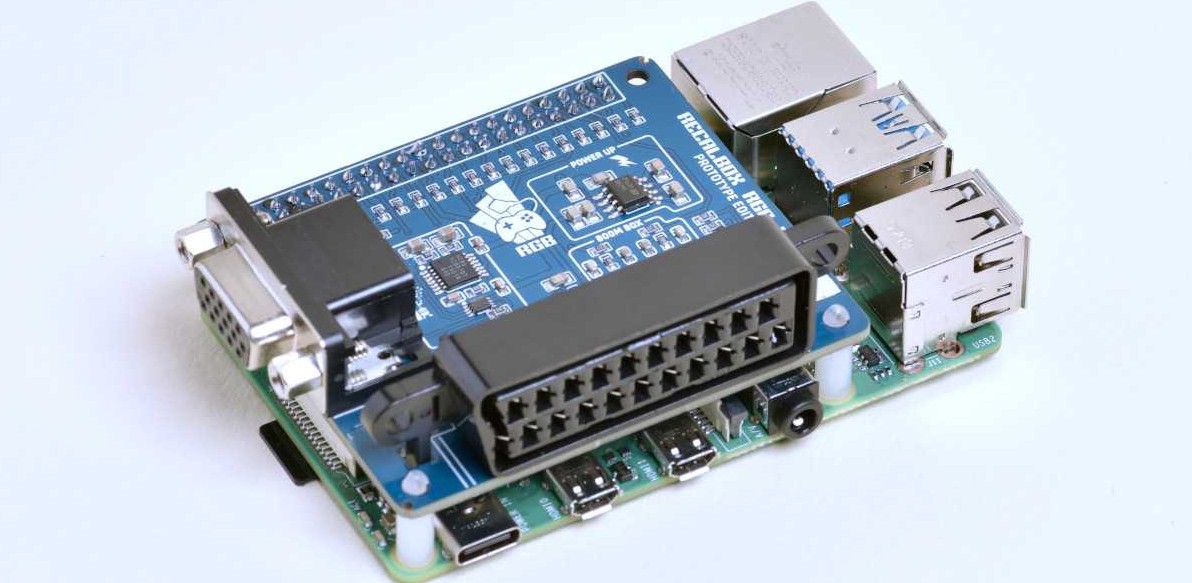
In 2021, Recalbox 8.0 introduced Pi Zero 2W compatibility and surpassed 120 supported systems. Automatic overlays, Mega Drive 16:9 management, and above all the launch of Recalbox RGB DUAL, allowing players to enjoy an authentic signal on CRT displays.
2023 — The age of arcade
In 2023, Recalbox 9.0 put a strong focus on arcade gaming with the launch of RGB JAMMA, bringing many arcade cabinets back to life. The release also included GPI Case 2W compatibility, 4K Kodi integration, and optimized Bluetooth management.
2024 — Modernization and new platforms
In 2024, Recalbox 9.2 extended compatibility to the Raspberry Pi 5 and Anbernic RG351 consoles. It also introduced virtual arcade systems, an optimized HD 16:9 mode, and a modernized Web Manager.
2025 — 10 years and V10

The year 2025 marks a major hardware milestone with Recalbox 10.0: RGB DUAL 2, RGB JAMMA 2, Steam Deck compatibility, experimental Guncon 2 support, RecalTower, RecalCards, GameCube and Model 3 compatibility on Raspberry Pi 5, customizable RecalTower kits, and an integrated theme manager. A wealth of new features to celebrate ten years of adventure.
A long-term commitment
From its modest beginnings as a Raspberry Pi project to a retrogaming OS supporting advanced PC and arcade configurations, Recalbox is far more than just a collection of emulators. It represents a constant commitment to accessibility, performance, and above all, the preservation of video game history. The future looks bright with version 10.0, ready to push the boundaries of modern retrogaming even further.
But beyond all these technical aspects, another element—an invaluable one—has been with us for 10 years: you. The players, the enthusiasts, the nostalgic gamers, the RecalPotes… If Recalbox has become what it is today, it’s also thanks to you. Your encouragement, feedback, testing, and sharing on social networks are the true driving forces behind this project that we’ve been building together for a decade. Thank you for being part of this adventure.