Blog

    1

Sat Dec 13 2025

PlayStation x Anicorn: when the PS1 becomes a luxury mechanical watch

Sony and Hong Kong–based watchmaker Anicorn are celebrating the 30th anniversary of PlayStation with a collection of exceptional mechanical watches. The centerpiece? A First PlayStation Limited Edition mechanical watch, produced in only 300 numbered units, paying tribute to the iconic 1994 console.

This collaboration comes at a time when gaming-themed watches are multiplying. Casio recently launched its Pac-Man collection to mark the franchise’s 45th anniversary, offering four models featuring the colorful ghosts and the famous “WAKA WAKA”. But the Anicorn x PlayStation watch clearly plays in a very different league.

A mechanical watch that justifies its price

According to The Gadgeteer, what sets this watch apart from typical gaming collaborations is the seriousness with which the team treated the source material. Where many brands simply slap a logo onto a generic quartz movement and double the price, Anicorn and Sony appear to have taken a very different approach.

Priced at $780, the watch features an automatic Miyota movement visible through a sapphire exhibition caseback. The stainless steel case echoes the faceted lines and matte gray tone of the PS1 console. The dial showcases a raised PlayStation logo at its center, with the iconic PlayStation button symbols positioned at 12, 3, 6, and 9 o’clock as applied 3D hour markers. The hands replicate the Start and Select buttons of the original controller.

Designed to appeal to collectors

Each watch is delivered with a Memory Card featuring NFC technology. Pair it with your smartphone to access a “Digital Memory Board” — a modern reinterpretation of PS1 save management, now designed “to tell your own stories”. In practice, this feels more like a collectible gadget than a truly functional accessory. The watch will also come packaged in a metal case styled in the colors of the classic PlayStation.

Two Play Symbol quartz models

Alongside the anniversary piece, Anicorn is offering two Play Symbol quartz watches, Dark Mode and Light Mode, priced at $250 each. These models display the PlayStation symbols using an oil-filled display (yes, really), creating a smooth, distortion-free visual field. The symbols appear to float and animate with every movement of the wrist.

Release on December 19

The PlayStation x Anicorn collection will be available exclusively on Anicorn’s website starting December 19, 2025, at 10:00 PM EST (4:00 AM on December 20, French time). With only 300 units produced for the flagship model, sales are expected to sell out within minutes.

Read more...
PlayStation
Anicorn
User

Fri Dec 12 2025

Clair Obscur: Expedition 33 wins Game of the Year

In a historic triumph for the French video game industry, Clair Obscur: Expedition 33 won the title of Game of the Year at the 2025 Game Awards, becoming the first French game to earn this prestigious distinction. Even better: with nine awards in total, the RPG from Montpellier-based studio Sandfall Interactive breaks all records and delivers a masterclass to the AAA giants of the industry.

As reported by PC Gamer, Clair Obscur: Expedition 33 won nine trophies at the 2025 Game Awards, surpassing even Baldur’s Gate 3, which had taken “only” six in 2023. The list of awards is impressive: Game of the Year, Best Narrative, Best Game Direction, Best Art Direction, Best Score and Music, Best Independent Game, Best Debut Indie Game, Best Performance (Jennifer English) and Best RPG.

A historic record

According to GameSpot, after breaking the record for the most nominations with 13 (a first in the 12-year history of The Game Awards), Expedition 33 has officially become the most awarded game in the history of the ceremony. The previous record belonged to The Last of Us: Part II with seven wins in 2020.

French pride

As highlighted by France Info, this is a historic first for a French title. Guillaume Broche, the game’s creative director, took the stage with his entire team dressed in striped sailor shirts and red berets, a nod to the very French costumes designed for the game’s heroes. “You changed our lives and the life of our studio, and it’s truly wonderful,” he said.

Developed by Montpellier-based studio Sandfall Interactive, the game takes place in a post-apocalyptic world inspired by Belle Époque Paris. Having sold more than five million copies since its release in April 2025, it has become a global phenomenon and one of the surprise hits of the year.

An indie victory over AAA giants

What’s most remarkable about this achievement? Clair Obscur: Expedition 33 was developed largely by just about thirty people — a modest team compared to the hundreds of developers involved in AAA productions. For many team members, it is their first game.

“We wanted to make a small game, but with big ambitions,” explained co-founder François Meurisse in his acceptance speech. “It was a daily challenge.” A challenge brilliantly met, proving that with creativity, passion, and talent, an independent studio with limited resources can surpass the industry’s giants.

In their speech for the Best Independent Game award, the studio dedicated their victory “to the indies who put creativity first and move forward with limited resources.” A statement that resonates strongly at a time when AAA game budgets are exploding (sometimes exceeding 200 million dollars) without necessarily guaranteeing quality or innovation.

Read more...
Clair Obscur Expedition 33
Game Awards
Cocorico
User

Mon Dec 08 2025

Feature: Why Do Our Old Consoles Turn Yellow?

If you own a Super Nintendo, a NES, a Dreamcast or an old Amiga computer, you’ve probably noticed this frustrating phenomenon: the original light-grey or white plastic has turned yellow, sometimes even brown in the most extreme cases. This yellowing, which mainly affects consoles and computers from the 1980s and 1990s, is no accident. Here’s why it happens — and what people have tried to do about it.

The culprit: brominated flame retardants

The main offenders are brominated flame retardants added to the plastic. To understand why, we need to go back to the safety standards of the time.

In the 80s and 90s, manufacturers had to comply with strict fire-safety regulations. To ensure their consoles didn’t catch fire too quickly in case of an electrical issue, they added bromine (a chemical compound) to the ABS plastic (Acrylonitrile Butadiene Styrene) used for the shells. Nintendo officially confirmed that the Super NES — like their other systems — was made from plastic containing flame-retardant chemicals to meet safety requirements.

The problem? When this bromine is exposed to UV light (from sunlight or even artificial light) and oxygen in the air, it oxidises. This chemical reaction gradually turns the plastic yellow.

Why does it yellow even in the dark?

A surprising fact: some consoles yellow even when stored in sealed boxes! Some owners found their brand-new Super Nintendo already slightly yellowed despite being kept untouched in its packaging for years.

Why? Oxygen alone is enough to trigger the process — UV light simply accelerates it dramatically. It’s a bit like metal rusting: it eventually happens even when stored away.

Why do some parts yellow more than others?

One of the most frustrating mysteries: on the same Super Nintendo, the top shell can turn very yellow while the bottom half remains perfectly grey. Several explanations exist:

Different production batches: Only certain batches had this issue, and later SNES models no longer suffered from it. Nintendo seems to have adjusted the flame-retardant dosage during production. The top and bottom of your console may simply come from two different batches with slightly different compositions.

Uneven exposure: The top of the console is much more exposed to light than the bottom. More UV = more yellowing.

Cigarette smoke?: Contrary to popular belief, cigarette smoke is often wrongly blamed for yellowing. It can leave a yellowish layer of dirt (which can be cleaned), but true yellowing comes from the plastic chemistry itself.

How does it work exactly?

Without diving too far into chemistry: ABS plastic is made of three components (Acrylonitrile, Butadiene, Styrene). When UV light and oxygen react with bromine-loaded plastic, they create molecules that absorb blue light. As a result, our eyes see yellow-orange.

The miracle solution? Retrobright

Since the mid-2000s, enthusiasts have been using a technique called Retrobright to reverse yellowing. The original discovery came in March 2008 from the CBM museum in Wuppertal, Germany, which found that immersing plastic pieces in a hydrogen-peroxide solution for several days could partly reverse the process.

The principle

Retrobright uses hydrogen peroxide, a small amount of TAED as a catalyst (commonly found in laundry boosters), and a UV light source. The mixture is applied to the plastic, which is then exposed to UV light (sunlight or a UV lamp). The peroxide breaks the chemical bonds responsible for the yellow colour.

What methods exist?

There are indeed several:

1. Immersion method: Using a mixture of 3% hydrogen peroxide and distilled water, then letting the pieces sit in the sun for around 8 hours.

2. Gel method: Creating a thick gel using peroxide and a thickener (such as xanthan gum), then applying it with a brush. It’s more economical because it uses less product.

3. Vapor method (the newest): Discovered by Simon Lock, this method uses hydrogen-peroxide vapour. A small amount of food-grade peroxide is placed inside an airtight container along with the plastic piece. The advantage? Far less product required and more even results.

Bigkam shares his solution (2022 video)

Don’t try this at home!

It’s dangerous! Concentrated hydrogen peroxide can cause chemical burns. These operations are done by experienced and properly equipped hobbyists.

Variable results: It works better on some plastics than others. Game Boys, NES consoles and controllers generally react very well. Grey consoles can be trickier.

The big issue: it’s not permanent, and side effects appear

Many “Retrobrighters” noticed their consoles slowly yellowed again a few months after treatment, even though they were stored safely, wrapped, and protected from light.

Yellowing returns after six months to a year and a half — even without direct light exposure. Why? Because Retrobright doesn’t repair the plastic; it only “bleaches” the surface. The bromine is still inside the plastic and keeps reacting.

Some hobbyists recommend applying a protective varnish after treatment to slow down re-oxidation, but nobody really knows if this works long-term.

Does Retrobright weaken the plastic?

This is a debated topic. Some argue that it doesn’t weaken plastic because the reaction only occurs on the surface. Others are more cautious. What’s certain is that yellowed plastic is already weakened by oxidation — which is why old consoles often crack during disassembly.

A recent article on Time Extension also reports negative experiences, notably on a Dreamcast.

How to prevent yellowing?

The best strategy is prevention:

  • Avoid direct light: Keep consoles away from windows or strong lamps
  • Stable temperature: Avoid heat sources and sudden temperature changes
  • Smart storage: A cool, dry, dark area is ideal
  • Airtight packaging: Some use airtight bags with desiccant packs

But let’s be honest: even with all these precautions, some consoles will still yellow. It’s in their chemical DNA.

Conclusion

Yellowing in old consoles is the result of an unfortunate combination: the fire-safety requirements of the 80s and 90s (which required brominated flame retardants) and the chemistry of ABS plastic exposed to UV light and oxygen. It’s a natural, nearly unavoidable process.

Retrobright can give your consoles a second youth, but it’s temporary and may cause irreversible side effects. You’ll need to be cautious if you decide to try it. For some collectors, the yellowing is even part of the charm and history of the console.

In the end, whether you choose to treat your consoles or embrace their aged look, the most important thing is that they still work — and keep bringing back magical retrogaming memories!

As for us at Recalbox, we’ve found our own solution: we made a black RecalTower!!!

Sources

  • Vintage Computing & Gaming – "Why Super Nintendos Lose Their Color"
  • The Old School Game Vault – "Why Video Games and Consoles Turn Yellow" (2025)
  • RetroGamingStores.com – "Why Does the Super Nintendo Turn Yellow?"
  • RetroJimmy – "The Curious Case of the Yellowing Super Nintendo" (2025)
  • Nintendo Life Forums – Discussion on SNES yellowing (2012)
  • Wikipedia – "Retrobright" (January 2025)
  • Medium – Thomas Fuchs, "How to retrobright old yellowed plastic" (2021)
  • Retrocomputing Stack Exchange – "Definitive guide to retrobright?"
  • Hackaday – "Plastic Cleanup Via Retrobrighting" (2020)
  • RetroRGB – "New RetroBrite Method Discovered | The Vapor Method" (2022)
  • Obligement.fr – "Utilisation du Retr0Bright"
  • Darius-Saturn.com – Forum on yellowing and Retrobright (2020)
  • LoisirCreatif.net – "Le retrobright, anti jaunissement des consoles" (2020)
  • VoxGaming.fr – "Retrobright, le tuto ultra complet"
  • Jonathan Dupré – "Mon retour sur le Retr0bright" (2022)
  • Forums Gamopat – Discussions on Retrobright (2019–2021)
  • HFS Play Forum – "RetroBrite: Donnez un coup de neuf à vos plastiques!" (2015)
Read more...
Hardware
Entretien
Consoles
User

Sun Dec 07 2025

An ultra-rare SegaSonic the Hedgehog arcade cabinet up for auction

An exceptionally rare SegaSonic the Hedgehog arcade cabinet is going up for auction on December 19 at Ewbank's in the United Kingdom. Estimated between £20,000 and £40,000 (around €23,000 to €46,000), this Multi Cabinet Swing unit comes from the legendary Sega World at the Trocadero in London and stands as a unique piece of Sega’s arcade-era history.

As reported by Time Extension, this machine is the only officially translated English version of the 1993 arcade game SegaSonic the Hedgehog, where players control Sonic, Mighty the Armadillo, and Ray the Flying Squirrel as they try to escape Eggman.

An exceptional journey

The cabinet was installed at Sega World London between 1996 and 1999 before being retrieved when the venue closed that same year. Since then, it has passed through the hands of several private collectors and was even displayed in the boardroom of Sega’s European headquarters. More recently, it was used during a promotional McLaren x Sega event for Sonic Racing: CrossWorlds.

As noted by a commenter on Time Extension, “This type of Sega Swing cabinet is incredibly rare on its own, even more so with a SegaSonic board and a control panel with trackballs in it.”

Mystery surrounding the English version

One detail particularly intrigues the community: although Ewbank's claims this is the only English-translated version of the game, some accounts suggest that even Sega World London only used the untranslated Japanese version. As one observer notes, “I’ve got images of the game being played at SegaWorld London, and they even show that they only had the untranslated Japanese import. Maybe it was swapped out after SegaWorld closed?”

Condition and accessories

According to Ewbank's, the cabinet has been fully tested and is in perfect working order. The lot also includes several extras: reproduction decals, two alternate/interchangeable control panels, and a working key with a Sega-branded cord.

A historic auction

According to Retro Dodo, this cabinet represents a significant slice of Sega’s history. For museums, preservationists, and dedicated collectors, it’s a rare opportunity to secure an important artifact from Sega’s arcade heritage.

The auction will begin on December 19 at 11 a.m. (UK time) at Ewbank's. With its remarkable history, operational condition, and the extraordinary rarity of its translated version, this SegaSonic the Hedgehog Multi Cabinet Swing stands out as one of the most distinctive arcade artifacts to reach the UK market in years. Time will tell whether it reaches — or even surpasses — its high estimate of £40,000.

Read more...
SEGA
Sonic
Arcade
User

Sat Dec 06 2025

Retromania: Micromania launches a buyback program for retro and old-gen games

Micromania is making a major strategic shift by launching Retromania, a new offer dedicated to pre-owned retro games and consoles. After years of focusing on current-gen, the French retailer is now opening the door to buying back PS1, PS2, PS3, GameCube, Wii, the original Xbox, and many other iconic platforms.

As reported by Xboxygen, the offer is now available across the entire Micromania network, both online and in stores, with more than 700 pre-owned retro games already listed. The system covers a wide range of old-gen platforms.

Eligible platforms

The range of accepted systems is impressive:

  • Sony: PS1, PS2, PS3, PSP, and PS Vita
  • Nintendo: GameCube, Wii, Wii U, DS, and 3DS
  • Microsoft: Original Xbox and Xbox 360

For now, the offer is limited to these platforms, but the retailer does not rule out expanding it later on. Note that retro console trade-ins are not yet available, though changes appear to be on the way.

Strict trade-in conditions

Trade-ins are only accepted if games are sold in their original box with manual, in complete condition. Buybacks are primarily offered as store credit, with a 25% reduction applied for cash payments. Games must be in good condition, and Micromania reserves the right to refuse any product that does not meet its criteria.

A pricing model that needs refining?

While some welcome the initiative, the pricing of games is already stirring controversy within the community. Some titles are bought back at very low prices despite having a high market value.

Conversely, some rare games seem fairly priced. Rule of Rose on PS2 is bought back at 195 euros, a coherent price given its current second-hand market value (150 to 200 euros on eBay). The Micromania teams are still fine-tuning the offer, and prices were recently updated.

A clearly assumed strategic change

For Micromania, this shift toward retro gaming follows a dual logic: on one hand, profit margins on new games are collapsing due to online competition and the rise of digital-only releases. On the other hand, the retro gaming market is booming, with growing demand for games and consoles from previous generations.

The initiative is also an opportunity for players who want to free up space and give a second life to their dormant games. To check trade-in prices, visit Micromania’s dedicated page.

After turning its back on retro gaming for years, this return to its roots marks a strategic turning point. Time will tell whether Micromania can strike the right balance between profitability and fair pricing to win over the collector community in the long run.

Read more...
Retromania
Micromania
User

Thu Dec 04 2025

RecalCards: functional and programmable Recalbox cards

If there’s one object that truly represents our passion for retrogaming — and has even become part of pop culture — it’s the game cartridge, a real symbol for many of us. A single glance at some of them is enough to awaken long-dormant memories.

A real ritual before our gaming sessions, almost sacred: who remembers gently removing a cartridge from its case, blowing into it, sliding it into the console with that unmistakable sound, and hoping the game would start on the first try?

While we’re lucky today to have extraordinary emulation solutions that let us relive our childhood, that unique magic only original hardware could offer is sometimes missing.
So an idea emerged: what if Recalbox released its own game cartridges?

We are thrilled to introduce the RecalCards: collectible and programmable Recalbox cards!

The idea is simple: allow Recalbox users to rediscover that familiar old gesture by choosing a physical RecalCard and inserting it into a dedicated reader to launch the corresponding game from their library (after blowing into it, of course).

RecalCards are brand-new collectible cards designed specifically by and for Recalbox. Delivered blank, you can program them yourself by telling Recalbox which game to launch when a specific RecalCard is inserted. This will be done directly through the Recalbox menu, and it’s accessible to everyone.

The Card Reader: the new Recaltower module

To use your RecalCards, we imagined a new module that fits directly into your Recaltower (whether you own the RGB Dual 2 or not). The Card Reader sits on top of your Recaltower and can be customized to match the colors of your favorite console. It’s ready to use straight away, with no software configuration required.

Once your RecalCards are assigned to games, using them becomes child’s play: turn on your Recalbox, pick the cartridge for the game you want to launch, insert it into the Card Reader, and the game starts automatically — with no menu navigation needed.

While you’re in-game, simply remove the RecalCard from the reader to return instantly to the Recalbox menu.

If a RecalCard is inserted when you power on your Recalbox, it will boot directly into the associated game without showing the startup screen (you can disable this option if you prefer the normal boot). The experience mirrors that of our old cartridge-based consoles — the reflexes come right back!

More details on wiki here.

Collector RecalCards for our Level 2 and Level 3 Patrons

But that’s not all! To thank our Patrons who support Recalbox on Patreon, we will send them exclusive collector RecalCards every two months to grow their collection.

Level 2 Patrons will receive 1 RecalCard every two months.
Level 3 Patrons will receive 3 RecalCards every two months.

These collector RecalCards will feature some of the most iconic retrogaming titles — genuine little collectible items with golden connectors and labels designed by the Recalbox team. A stylish way to launch your favorite games.

We already have 16 RecalCards in development for the first season, each paying tribute to a memorable game from our childhood. True collectible items that we can’t wait to show you.

Season 1: 16 Collector RecalCards

We have already planned Season 1 with 16 collector cards paying tribute to the cult games of our childhood. Each shipment will be a surprise, a new piece of nostalgia that only you can collect.

  • Level 2 Patrons: Build an exclusive collection over the months (6 collector cards per year)
  • Level 3 Patrons: Speed up your collection with 18 collector cards per year.

Regardless of when you subscribe or upgrade from Level 1 to Level 2 or 3, you will receive the RecalCards in order, meaning you will receive 1 out of 16 first. In addition, Level 2 Patrons will receive the entire season (as long as their subscription is active), so they won't miss any RecalCards, but will receive them over a slightly longer period of time. This way, you can be sure to complete your collection with peace of mind.

We hope this new project will mean as much to you as it did to us while imagining it. Whether you’re a collector, a fan of launching games “the old-school way” (don’t forget to blow into the cartridge!), or someone who simply enjoys letting your RecalCards sit next to your Recaltower to spark curiosity among your guests, we can’t wait to send you your first cards.

Read more...
RecalCards
Card Reader
Hardware Recalbox
User

Mon Dec 01 2025

The Theme Manager arrives on Recalbox

It was eagerly awaited by many of you, and it’s finally here! The Theme Manager has arrived in Recalbox V10.0-Patron-4! Here’s a full breakdown of what’s new:

As you know, V10 has been an opportunity for Recalbox to get a fresh new look. A new theme has been available since Patron 3, giving patrons the chance to vote for their favorite style — and more than 160 of them participated! The default theme you’ll discover in the final V10 release will be the direct result of this vote.

We would like to warmly thank our patrons for their participation and involvement: we carefully read all their feedback and comments, each more insightful than the last.

While this new theme is fully customizable through the menu so that everyone can tailor it to their taste, some users prefer more distinctive interfaces through different themes. That’s why we’re introducing the Theme Manager.

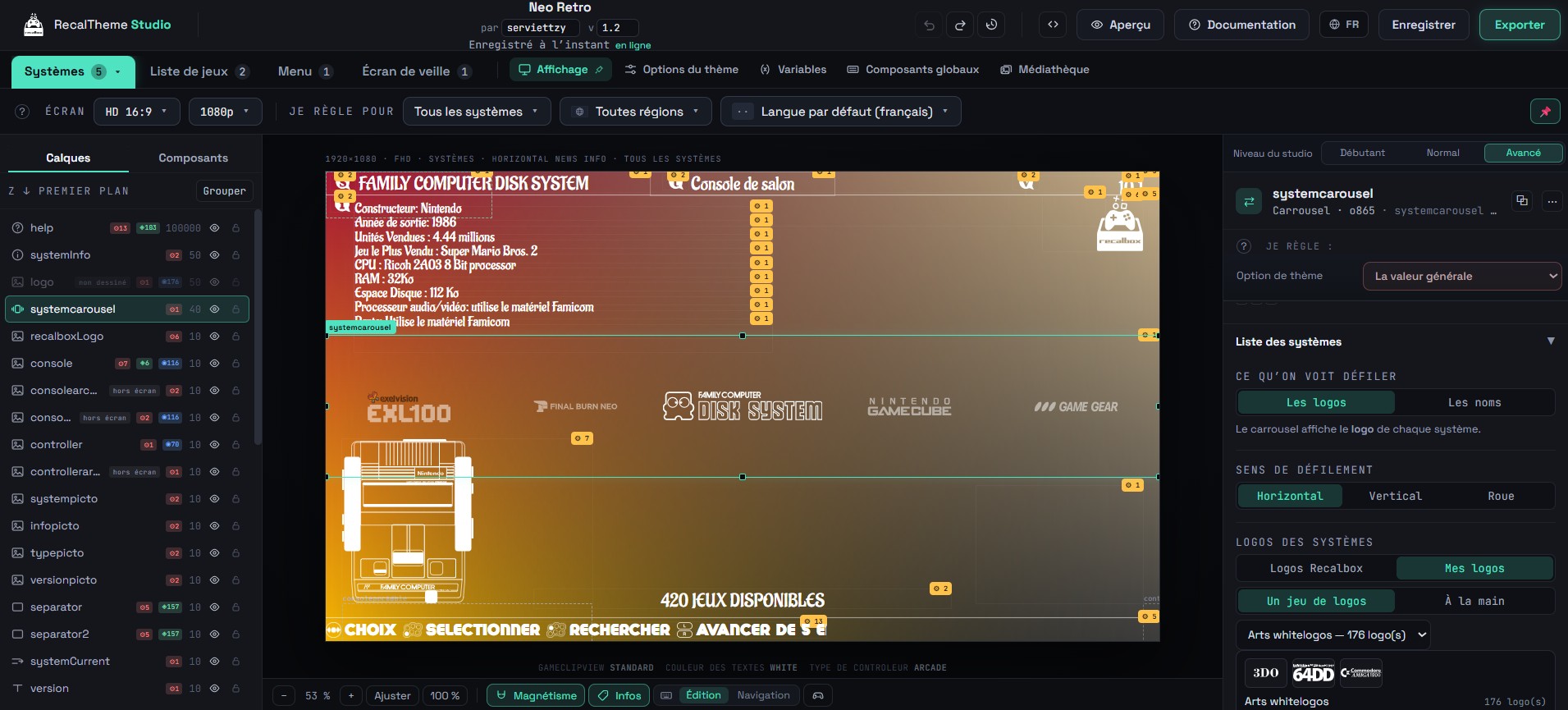
Directly accessible from the main Recalbox menu, the Theme Manager lets you select radically different themes to give your interface its own identity — both in the “systems” view and in the “games” view. Neo Retro, Minimalist, Xbox… some themes are completely opposite in terms of aesthetics. New themes will be added over time.

Note that some themes may be compatible with CRT, HDMI, and TATE formats, while others may support only one of the three display types (you’ll get a message if you try to apply an incompatible one). Icons will show you which formats are supported by each theme.

You can switch themes on the fly, without rebooting — either through the Theme Manager or directly in the user interface options, as long as the theme has been installed once through the Theme Manager (these two menus will be merged later on).

But that’s not all: to thank our Patrons for their support and participation in shaping the new theme, they will enjoy two exclusive themes:

  • The “Astro” theme, created by Beudbeud: a 100% CRT theme inspired by the AstroCity universe, perfect for arcade lovers.

  • The “Art'nPop” theme, created by Bounitos: compatible with all formats and featuring a unique illustration for each system.

Finally, if you’re a “theme maker” yourself, you can submit your creation to the Recalbox team so it can be made available directly in the Theme Manager for everyone (and of course, you will be credited!). And if you decide to embark on the theme-making adventure and need help, our Master Theme Makers are available on the #themes channel on Discord!

Feel free to share your favorite themes with us on Discord or the Facebook group — it will mean a lot to the creators. And if you want to submit your own themes, we’re all ears!

Read more...
Theme Manager
V10
User

Sun Nov 30 2025

One Credit Challenge #07 : Spinmaster

You’ve barely recovered from sweating through the maniac shooter Armed Police Batrider in the previous challenge, and you think you can finally relax? Think again! The 7th One Credit Challenge throws you into Spinmaster — as cute as it is explosive!

Spinmaster is a colorful, adrenaline-packed run & jump developed by Data East in 1993 for the Neo·Geo MVS. You follow Johnny and Tom, two adventurers searching for a stolen artifact, in a cartoony atmosphere reminiscent of both Joe & Mac and 90s animated shows. The game stands out immediately thanks to its art direction: super-smooth animations, expressive characters, and richly detailed environments.

The gameplay focuses on ultra-dynamic action built around a customizable boomerang that can take several forms (yoyo, missiles, flames…). It’s easy to pick up and very accessible, yet surprisingly intense thanks to numerous special attacks and multi-phase boss battles. With its fast pace, zero downtime, and level design mixing platforms, waves of enemies, and little surprises, the game keeps players constantly on their toes.

In co-op, Spinmaster becomes even more chaotic and fun: combined attacks, screen-filling effects, and generous power-ups make it a fantastic pick for two-player arcade sessions. But for this challenge, you’ll have to score as high as possible solo. With its short but intense playtime, charming art style, and punchy gameplay, it remains one of the Neo·Geo’s must-play titles.

🏆 Challenge rules

Your goal is to achieve the highest score using a single credit.
The challenge runs from December 1st to December 15th, 11:59 PM. You can make as many attempts as you want.

📢 How to participate?

  • Launch the game (rom spinmast)
  • Play and try to beat the high score
  • Take a screenshot or photo of your final score
  • Share it on the Discord #challenges channel with your username and score

⚖️ Rules to follow

To ensure a fair competition:

The score must be achieved in one single credit, with no save states, no rewind, no cheats, and no auto-fire (unless built into the game).

Gentlemen’s agreement: glitches that artificially inflate the score are also forbidden.

🎁 Rewards & fair play

The goal of the challenge is above all to discover games, share tips, and have fun — all with a friendly competitive spirit!

The winner will receive a game key (GOG, Steam, etc.) chosen from a list of about 100 titles.
If you’ve already won a challenge in the past three months, the reward goes to the next player.

Your ranking will be added to the One Credit Challenge leaderboard.
The champion of the first season will win either a free RGB Dual 2 or a one-year Recalbox Patreon subscription.

Good luck everyone, and may the highest score win!

Read more...
One Credit Challenge
Arcade
Spinmaster
Neo Geo
Data East
User

Sat Nov 29 2025

Recalbox 10.0-Patron-4 is now available for our Patrons

We are delighted to introduce Recalbox 10.0-Patron-4 — a major milestone release marked by the arrival of the Theme Manager and numerous improvements for handheld consoles and CRT displays! Please note that this version is currently exclusive to users supporting us on Patreon, before being rolled out to everyone in a few weeks.

Many thanks to our patron testers for their active participation during the alpha phases! 🙏

THE New Feature: The Theme Manager

The flagship feature of this release! You can now:

  • Browse, preview, and install themes directly from our online repository
  • Update or delete your themes in just a few clicks
  • Access the options of any installed theme (Y button)

A true revolution for personalizing your Recalbox!

Note that the new default theme is now fully compatible with handheld consoles (Odroid, Anbernic, GPi Case…), TATE mode, and CRT displays with dedicated options.

CRT: New Improvements

  • Fixed fullscreen option on Game Gear
  • Multiple adjustments for 240p mode
  • Functional Game Boy / Super Game Boy selection on CRT
  • Option to remove the gradient in the theme

Other Important Updates

  • Amiga: lr-puae becomes the default core on RPi5 and PC
  • Return of user scripts: run your custom Bash and Python scripts directly from the Recalbox menu
  • Fix for the RPi5 power button when exiting games
  • Faster shutdown and reboot on Raspberry Pi 5
  • Numerous interface fixes (popups, SVG, missing characters)

Full Release Notes

To view the complete list of fixes and improvements in this version, head to:

👉 Full Release Notes

Read more...
Patron 4
Patreon
V10
User

Thu Nov 27 2025

Nintendo acquires Bandai Namco Studios Singapore: a strategic boost for its future games

Nintendo has just announced the acquisition of Bandai Namco Studios Singapore, a strategic move that will strengthen its internal development capabilities. The studio, specialized in creating graphical assets, will become Nintendo Studios Singapore starting in 2026.

Nintendo confirmed the news in a statement detailing the acquisition of 80% of the shares of Bandai Namco Studios Singapore (BNSS), with full ownership expected after a transition period. Established in Singapore in 2013, the studio does not develop complete games but is an expert in producing visual assets: 3D models, environments, animations… A skill set it has already contributed to Nintendo projects in the past, notably within the Splatoon franchise.

Why this acquisition?

Nintendo explains that it wants to reinforce its development structure. By integrating BNSS into its ecosystem, the company gains more direct control over a crucial part of the artistic production of its future games.
It’s a form of vertical integration: less reliance on external contractors, more visual consistency, and tighter control over asset quality.

It’s worth noting that this is absolutely not an acquisition of Bandai Namco as a whole, but only of one of its specialized subsidiaries based in Singapore.

What will this change?

Starting April 1st, 2026, the studio will officially become Nintendo Studios Singapore.
Its role will remain similar, but from now on it will work exclusively on Nintendo projects.
Even if the immediate financial impact is expected to be limited, this move could help Nintendo accelerate or streamline certain development steps in the medium term.

And for players?

For the general public, this acquisition won’t bring any visible change overnight.
But in the long run, it could improve the artistic coherence of Nintendo’s productions… and potentially reduce some development timelines.

At a time when many video game companies are refocusing their resources and internalizing their processes (sometimes at the cost of massive layoffs), Nintendo once again demonstrates its intention to control every creative step behind its flagship franchises.

Sources:

Read more...
Nintendo
Bandai Namco
User

Thu Nov 27 2025

Nike Air Max 90 transformed into a functional Super Nintendo

To celebrate the 35th anniversary of the Super Nintendo, designer Gustavo Bonzanini created the AIR SNES, a pair of custom Nike Air Max 90s that don’t just feature a design inspired by the legendary console: they actually work as a real game system. A bold artistic project blending sneaker culture and retrogaming.

As reported by Engadget, the idea came to Bonzanini after noticing the many collaborations between sneaker brands and video game franchises. “I always wondered: wouldn’t it be cool if these shoes that look like video games actually worked as consoles?” the designer explained in a statement.

A Raspberry Pi hidden in the shoe’s tongue

Since it was impossible to fit the bulky components of an original SNES inside a wearable shoe, Bonzanini opted for emulation. He used a Raspberry Pi Zero W placed inside the sneaker’s tongue for easy access. A small rechargeable battery powers the system, offering up to 30 minutes of gameplay before needing a recharge.

Even though the Raspberry Pi includes a built-in Mini HDMI port, Bonzanini added an analog converter to connect the AIR SNES to a television using classic RCA cables. A deliberate choice to recreate an authentically retro experience.

Design and gameplay experience

The colors come directly from the Super Nintendo’s palette. The soft grey suede upper evokes the console’s matte shell, while the purple tone appears on various parts of the sneakers.

To play, you simply connect an SNES controller. Bonzanini modified his with an 8BitDo Bluetooth kit, preserving the original feel while adding the convenience of modern wireless connectivity. Despite the embedded electronics, the AIR SNES weighs only a few grams more than a standard pair of Air Max 90s. The shoe’s air-cushioning system remains intact, ensuring comfort for extended wear.

A unique piece of art

Bonzanini explicitly presents his project as a work of art rather than a commercial product. “This artistic project was my way to celebrate both worlds and push the boundaries of what sneaker culture and technology can become when they merge,” he said.

Unfortunately for collectors, the AIR SNES is a one-of-a-kind creation with no commercial plans. Bonzanini crafted the sneakers in his workshop in Brazil, and they will remain a unique piece celebrating two inseparable icons of the ’90s: the Super Nintendo and the Nike Air Max 90, both released in 1990.

At a time when retrogaming is thriving and sneaker culture has never been more popular, the AIR SNES stands as a creative expression of this dual passion—a reminder that innovation can emerge in the most unexpected places when it comes to retrogaming.

Read more...
Nike Air Max 90
Super Nintendo
User

Tue Nov 18 2025

Ridge Racer adapted for GBA: a promising homebrew project

The Game Boy Advance was never known for its ability to handle polygonal 3D. Yet Gustavo Valiente has taken on the seemingly impossible challenge with his “RR Project”: porting Ridge Racer, Namco’s 1993 arcade classic, to Nintendo’s handheld. And against all odds, the result is impressive.

As reported by Time Extension, the GBA did receive a few unlikely ports back in the day — including Crazy Taxi and Jet Set Radio — but this homebrew project might well surpass all of them in terms of technical achievement.

A 3D engine developed from scratch

Gustavo Valiente spent months recreating Ridge Racer from the ground up for the GBA, using his own Butano engine (written in modern C++) specifically designed to make Game Boy Advance development easier. The developer coded the 3D rendering engine himself, allowing the GBA to achieve what many thought was impossible.

To run the 1993 arcade game on much more modest hardware, compromises had to be made. Car models and roadside objects are extremely simple, using flat-shaded polygons, and the draw distance is significantly reduced. But these sacrifices pay off: the game runs at a steady 30 fps, and Valiente even managed to keep the announcer’s voice for that authentic Ridge Racer touch.

Enthusiastic reactions

According to NotebookCheck, despite the GBA’s relatively weak hardware, the port stays surprisingly faithful to the original and preserves Ridge Racer’s frantic, energetic atmosphere, with its 3D polygon tracks and cars. The draw distance is sufficient to allow good anticipation of corners.

Early online reactions have been overwhelmingly positive, with a perfect five-star rating on the project’s itch.io page. One commenter sums up the general sentiment: “It’s unbelievably good, I never thought this would be possible.”

A project in active development

No playable demo is available yet, but the project appears to be under active development. Valiente promises future updates with additional tracks and tweaks, taking inspiration from the expanded courses of the PlayStation port.

This project demonstrates what the homebrew scene can accomplish with pure determination. Ridge Racer, released in arcades in 1993, set new standards for real-time 3D visuals before becoming a true PlayStation system seller in 1994. Seeing this classic come to life on a handheld that was never designed for such a technical challenge is simply remarkable.

Read more...
Ridge Racer
Game Boy Advance
User

Sat Nov 15 2025

One Credit Challenge #06 : Armed Police Batrider

After stretching our brains with Pururun and its gelatinous blobs, it’s time for pure adrenaline with the sixth game of our One Credit Challenge: Armed Police Batrider, an intense vertical shoot ’em up that will put your reflexes to the test.

Armed Police Batrider is a vertical manic shooter released in arcades in 1998, developed by Raizing and published by Eighting. As the spiritual successor to Battle Garegga, this title stands out with its impressive roster: nine standard pilots plus nine unlockable characters taken from previous Raizing games. Each character pilots a flying jet bike (a Batrider) with their own shot and bomb characteristics.

Universe & gameplay

The action takes place in 2019 on Zenovia, an artificial island near Manhattan that has turned into a crime-ridden slum. Nine fighters are recruited as “Zero-Cops” to face the forces of GiganTech and their ultimate weapon, “Discharge.”

The game offers four modes (Training, Normal, Advance, and Special) with a team system inspired by The King of Fighters: you select three characters, each acting as one life. The power-up system is based on Shot and Option items, with five different levels. Depending on the mode, the game features up to 18 bosses, destructible environments, and a rank system (dynamic difficulty).

🏆 Challenge rules

Your goal is to achieve the highest score using a single credit.
The challenge runs from November 16th to November 30th at 11:59 PM. You can attempt as many runs as you like.

📢 How to participate?

  • Launch the game (ROM batrider)
  • Play and try to beat the best score
  • Take a screenshot or a photo of your final score
  • Share your score on the #challenges Discord channel along with your username and score

⚖️ Rules to follow

To ensure fairness:

Scores must be achieved using a single credit, with no save states, no rewind, no cheats, and no auto-fire (unless the game includes auto-fire by design).

Gentlemen’s agreement: using glitches that artificially inflate the score is also forbidden.

🎁 Rewards & fair play

The challenge’s purpose is above all to discover games, share tips, and of course, have fun — all in a friendly competitive spirit!

The winner will receive a game key (GOG, Steam, etc.) chosen from a list of about 100 titles.
If you have won a challenge in the last three months, the reward goes to the next player.

Your ranking will be added to the One Credit Challenge leaderboard.
The champion of the first season will win either an RGB Dual 2 or one year of Recalbox Patreon membership.

Good luck to all, and may the best score win!

Read more...
One Credit Challenge
Arcade
Armed Police Bartider
User

Fri Nov 14 2025

Analogue 3D: the N64 FPGA console finally steps out of the shadows

After numerous delays that have tested fans’ patience, the Analogue 3D is finally entering its final phase. The FPGA console dedicated to the Nintendo 64 is expected to begin shipping on November 18, 2025, according to Analogue’s official announcement. This news brings an end to more than a year of waiting for the first preorders.

As reported by Time Extension, if you placed an order between October 2024 (when preorders opened) and today, you shouldn’t have to wait much longer. But as highlighted by Rom Game, the story of this console has turned into a saga whose twists and turns have ended up frustrating a large part of the retrogaming community.

Repeated delays that erode trust

Announced in 2023 with a release planned for 2024, the Analogue 3D sold out just minutes after preorders opened in October 2024 (with a price of $250). But the initial excitement quickly gave way to a series of disappointments.

Delays piled up, constantly pushing back the launch. In July, after a full year of postponements, Analogue promised shipments would begin in August. That promise went unfulfilled: in August, the console was delayed again by several months. Even more frustrating, the company has been extremely reluctant to share footage of the console in action, limiting communication to brief teasers.

This lack of transparency fueled growing skepticism. Many began questioning whether the final product would live up to the hype. Some frustrated customers even canceled their preorders in favor of ModRetro’s M64, a competing device priced at $199.99 with far more transparent communication.

This time, it might really happen

According to Analogue, the first units will leave the warehouses on November 18, allowing players to rediscover their Nintendo 64 library just in time for the holidays. Customers have until November 16 to update their shipping address. The console remains out of stock on the official store in both colors (black and white), meaning latecomers will have to wait for the next batch.

A faithful hardware reproduction of the N64

Analogue’s goal is to recreate the internal hardware behavior of the Nintendo 64 using modern components. Unlike software emulation, FPGA technology replicates the original console’s hardware logic, theoretically ensuring perfect compatibility and zero latency.

The Analogue 3D connects to modern TVs and outputs games in 4K. It offers full compatibility with the global catalog (PAL, NTSC-U, NTSC-J) and includes four controller ports in the original format, preserving the authentic multiplayer experience that made the N64 so iconic.

A risky bet

The company is betting big on this launch. The repeated delays have damaged its reputation, while competitors seem to offer credible alternatives. The coming weeks will be decisive: if the feedback is positive, the brand may regain the community’s trust — and that’s all we can hope for.

Read more...
Analogue 3D
Nintendo 64
FGPA
User

Wed Nov 12 2025

A new theme for Recalbox 10: Patrons vote for tomorrow’s interface

Yesterday saw the release of Recalbox 10.0-patron-3, a version designed for our Patrons, giving them early access to the in-development V10 before its public release. While this new build comes with plenty of fixes, optimizations, and improvements, it stands out above all for its brand-new visual theme!

Indeed, version 10.0-patron-3 allows us to invite our Patrons to share their feedback and help the team decide on the new Recalbox interface that will appear in the coming weeks.

To do this, we’ve provided them with five presets (five preconfigured visual styles), available both on HDMI and CRT. They can switch between them instantly in the user interface menu, discovering the various possibilities for system layout, game lists, on-screen information, colors, animations, and more.

Two forms — one for HDMI and one for CRT — are available for them to vote and share their preferences regarding this new theme. These votes will then be analyzed by the team to create a default interface chosen by the Patrons.

Why a default theme? Simply because in V10, you’ll all be able to fully customize your theme. Like the general layout but want to hide certain details? You’ll be able to. Think the color bars are too thick? You can tweak them — colors, sizes, information, layouts: you’ll definitely find a style that suits you.

A little more patience while our Patrons cast their votes and we compile the results — and soon we’ll proudly present the new (fully customizable) theme, co-created with our community, available to everyone in the upcoming V10 release.

A huge thank-you to our Patrons who actively contribute to shaping the future of Recalbox.

Read more...
Theme
Recalbox
Patrons
User

Tue Nov 11 2025

Recalbox 10.0-patron-3: new interface, compatibility, and major optimizations

We’re thrilled to announce the release of Recalbox 10.0-patron-3! This early-access version, available to our supporters on Patreon, is the result of intense collaborative work with our volunteer patrons, who tested the alpha builds for over seven weeks on the #patrons-alpha Discord channel. A huge thank you to them for their dedication and invaluable feedback!

Complete Recalbox theme overhaul

The Recalbox theme has been completely redesigned, featuring brand-new system and game views you’ll definitely want to explore. Several presets are available so you can choose the one that best fits your style. The addition of colors for virtual arcade systems, drastically improved loading performance thanks to file caching, and numerous display bug fixes make the experience smoother than ever.

Regarding the new theme and its presets, we’ll also be asking for feedback from our patrons! To help us decide on the default theme for the future, Patrons have received forms via their Patreon space to share their impressions and preferences about the available presets.

Steam Deck: improve support

@Angelfred

The Steam Deck now enjoys full support, with HD and Widescreen modes enabled, fixed audio and touch management, the addition of a DeadZone for analog sticks, and Bluetooth support on the Steam Deck OLED. No more black screen freezes during reboot or shutdown!

Raspberry Pi 5: major optimizations

Model3 performance has been significantly improved thanks to the use of medium-resolution display modes. You can now exit games directly by pressing the Raspberry Pi 5’s Power button, and numerous fixes ensure greater stability overall.

CRT: significant improvements

@Corwin

CRT enthusiasts will be pleased: fullscreen or original display options for handheld consoles, fixed forced 240p modes on multisync monitors, a new option to force 384p on tri-sync screens, support for the Gearsystem core (Sega 8-bit) on CRT, and improved image quality on RGB Dual 2 in 480p.

Emulators and notable fixes

On the emulation side, this release brings plenty of updates: new libretro core genesisplusgx-ex for the Megadrive, a major PPSSPP update fixing save issues, Dolphin input fixes, migration to the new libretro-ps2 core (formerly lr-pcsx2) for better PS2 performance (PC only), and many more improvements.

The user interface has also received important fixes: a new option to disable fast scrolling in long lists, Quickjump moved to HOTKEY+X, and Markdown parser corrections.

This version includes dozens of other fixes and optimizations detailed in the full release notes. Keep sharing your feedback and suggestions — be part of building tomorrow’s Recalbox!

Once again, a huge thank-you to our Patrons for taking the time to test, report bugs, and share suggestions across multiple setups — things we could never have evaluated so quickly and efficiently on our own.

Happy gaming, everyone!

Read more...
Patrons
Patreon
Recalbox 10.0-patron-3
User

Fri Nov 07 2025

Xbouse: when Microsoft puts its foot in it...

Microsoft has just created one of the most unexpected buzzes of the gaming year — completely by accident. In an attempt at wordplay, the Xbox brand posted an image featuring the word “Xbouse.” The problem? In French, “bouse” literally means… cow dung. A clumsy pun that triggered a wave of mockery, especially among French-speaking gamers. A communication blunder that left a mark on the Redmond giant.

It all started with a simple promotional post on the official Xbox UK and Xbox US accounts. The image, meant to promote a campaign around the “Xbox House,” boldly displayed the word “Xbouse.” The result: an immediate flood of jokes and memes across social media.

According to Génération NT, the visual was quickly deleted — but too late: the hashtag #Xbouse was already trending. A linguistic slip that went viral, spreading like wildfire across the gaming world.

As Journal du Geek points out, the timing couldn’t have been worse for Xbox. Between criticism over Game Pass price hikes and doubts about the brand’s direction, this unintentional “joke” only fueled the frustration of part of the community. Ironically, “Xbouse” had already been a long-standing nickname used by some of the console’s detractors — before Microsoft accidentally made it official.

Meanwhile, All-Nintendo took a broader look at the situation, framing it as an example of the pitfalls of globalized communication. When a brand addresses multiple markets at once without proper local validation, a single word can take on a very different meaning.

Beyond the laughs, the “Xbouse” affair serves as a reminder that international marketing demands a perfect grasp of cultural and linguistic nuances. And while this story will likely remain just a funny anecdote for Xbox, it perfectly illustrates the risks of overly centralized communication — even for a gaming giant.

At a time when some gamers still argue over whether “the best console” has an X, a triangle, or a mushroom on it, this kind of blunder at least serves one purpose: reminding us that we all play for fun. At Recalbox, we’d rather grab a controller, fire up a classic Street Fighter II, and settle our “console wars” with a Hadoken or two… not with hashtags.
But hey — the SNES is still better than the Mega Drive.

Read more...
Xbouse
Xbox
Microsoft
oups
User

Fri Nov 07 2025

PCSX2 reaches 99.5% compatibility: almost the entire PS2 library emulated

We recently talked about the arrival of ARMSX2, a promising new PS2 emulator for Android that’s still in development. But while the mobile scene is catching up, PCSX2 on PC has just reached a historic milestone: the emulator now supports over 99.5% of the PlayStation 2 library. A victory for video game preservation.

As reported by OC3D, PCSX2 has now reached an almost perfect level of compatibility after more than 20 years of development. Out of the 4,000+ games released for the best-selling console of all time, only four remain unrated as “Playable” or “Perfect”: DRIV3R, Final Fantasy XI (which depends on online servers that are now closed), Marvel Nemesis: Rise of the Imperfects, and World Series Baseball 2K3.

A spectacular evolution in recent years

PCSX2’s progress has been remarkable: its compatibility rate increased from around 98% in 2021 to 99% by the end of 2023, and now stands at 99.5%. This improvement is the result of years of relentless work from the open-source community, with constant upgrades to the emulation engine, graphics compatibility, and performance.

Recent versions (2.4.0 released in July 2025 and subsequent updates) brought major advances: RT in RT support fixing many rendering issues, improved split-screen (Jak X and others), SDL 3.0 and Wayland by default on Linux, HDR optimizations, and a flood of bug fixes.

An essential preservation tool

Twenty-five years after the PS2’s release, original hardware is increasingly hard to find in working condition. PCSX2 ensures that the classics from this golden era remain accessible to future generations. And not just accessible — often improved, with higher resolutions, stable performance, and even HD texture pack support.

The emulator allows you to dump the BIOS from your own PS2 console and rip your physical games from their DVDs. You can then play them on your PC through emulation, often at higher resolutions and with performance boosts. It’s an excellent way to preserve your collection’s legacy and make it playable on modern hardware.

And on mobile?

As we mentioned in our article on ARMSX2, PS2 emulation on Android is also advancing. Based on recent PCSX2 code, ARMSX2 represents the future of mobile PS2 emulation thanks to its open-source nature. While its performance is still behind NetherSX2 for now, the project is evolving quickly and directly benefits from PCSX2’s ongoing improvements.

The retrogaming community now has exceptional tools to preserve and play PS2 classics — whether on PC with the near-final version of PCSX2, or on mobile with actively developed ARM emulators. God Hand, Final Fantasy X, God of War, Metal Gear Solid 3, Gran Turismo 4: all these masterpieces that shaped modern gaming remain accessible and playable.

Read more...
PCSX2
PlayStation 2
User

Sun Nov 02 2025

The Vectrex Mini launches its Kickstarter on November 3 starting at €99

The Vectrex, the cult 1982 console with its built-in vector display, is about to be reborn in miniature form. The Vectrex Mini project, led by the French team Neo Retro and headed by David "Flynn" Oghia, launches its Kickstarter campaign on November 3, 2025, at 4 p.m.

This miniaturized version aims to revive one of the true UFOs of video game history, as reported by Rom Game. The original Vectrex, developed by Smith Engineering and marketed by General Consumer Electronics, was revolutionary for its time: unlike its competitors such as the Atari 2600, which required a television, it came with its own 9-inch CRT display capable of rendering crisp, bright vector graphics.

A mini console that’s fully featured

The Vectrex Mini captures the spirit of the original in a casing half the size, produced using the same injection molding process as in the 1980s. At its core lies a modern ESP32 processor powerful enough to run the entire Vectrex library with performance surpassing many arcade cabinets of the era.

The 5-inch AMOLED screen (800×600 pixels) replaces the original cathode-ray tube, faithfully reproducing the legendary vector graphics with sharpness and brightness. Although it can’t perfectly recreate the phosphorescent glow of CRT vectors, the team promises an authentic and immersive result.

The console includes 12 classic preinstalled games (final lineup to be announced soon), mostly from the General Consumer Electronics catalog, along with their physical overlays. These colorful plastic sheets, placed in front of the screen to enhance minimalist graphics, were an essential part of the Vectrex experience — and Neo Retro has made sure to include them for the sake of nostalgia.

Pricing and editions

Early backers will be able to grab a “Founder’s Edition” starting at €99 for the first 50 units, followed by €129 for the next 300 orders, then €149 for everyone else. As reported by Games Radar, that’s surprisingly affordable for an all-in-one tabletop arcade system with an AMOLED screen.

A limited White Edition will also be offered at $250 (around €219), capped at 200 units. This “very NASA-punk” white version includes a numbered certificate of authenticity and a unique badge. David Oghia initially wanted a gold-plated Vectrex Mini, but the manufacturing process proved too complex.

Modern connectivity

The Vectrex Mini comes with several modern features: USB-C power (via outlet or power bank), a microSD slot to add more games, an included Bluetooth controller, and video output (USB-C or HDMI, final decision pending). There’s no cartridge slot for original Vectrex games — the console will only run preinstalled titles and additional ones via microSD.

Timeline and availability

The Kickstarter campaign launches on Monday, November 3, 2025 and will remain open throughout the month. Production is expected to take about 10 months after the campaign ends, with deliveries scheduled for late 2026. For now, Kickstarter will be the only way to get one.

For a console that never found commercial success in 1982 but became a collector’s cult favorite, the Vectrex Mini represents a rare opportunity to discover — or rediscover — this unique piece of video game history. See you on November 3 for all the campaign details.

Read more...
Vectrex
Kickstarter
User

Sun Nov 02 2025

ARMSX2: PS2 emulation on Android takes a new turn

PlayStation 2 emulation on Android has just reached a decisive new milestone. ARMSX2, a new open-source PS2 emulator based on PCSX2, was released in version 1.0 at the end of October 2025. And unlike its predecessors, this one might finally become the long-term solution for PS2 emulation on Android phones and tablets.

Since the discontinuation of AetherSX2 in early 2023, PS2 emulation on Android has been in a strange situation. NetherSX2, a fork of the abandoned project, works decently but relies on closed-source code that’s nearly five years old. ARMSX2 is here to change that.

An emulator based on the latest PCSX2 version

ARMSX2 stands out thanks to its modern foundations. Unlike NetherSX2, it uses the latest PCSX2 codebase, integrating all the optimizations and bug fixes from recent years. The project is fully open-source under the GPL 3.0 license, ensuring transparency and community-driven development.

Primarily developed by MoonPower with support from jpolo1224, ARMSX2 was born after years without any open-source PS2 emulator dedicated to ARM systems.

x86-to-ARM64: a temporary solution

A key technical detail: ARMSX2 uses a translation layer that recompiles PCSX2’s x86 code into ARM64 in real time. This approach, similar to Apple’s Rosetta 2, makes it possible to bring PCSX2 to ARM quickly — though at the cost of slightly lower performance for now.

As noted by Retro Dodo, the developers are transparent: performance is currently below NetherSX2, but this is a temporary situation. The team is actively working on optimization and doesn’t rule out a future transition to native ARM64 code.

Compatibility and availability

ARMSX2 runs on any device with a modern ARM64 processor: recent Android smartphones and tablets, as well as iOS, Linux ARM64, and Windows on ARM. Version 1.0.3 is available on GitHub, with a Play Store page coming soon.

As with any PS2 emulator, ARMSX2 requires a BIOS dump from a legitimately owned PS2 console. The user interface is simple and intuitive, with on-screen controls and Bluetooth gamepad support.

pocket-lint.com

The future of PS2 emulation on Android

As highlighted by Android Police, the community welcomes ARMSX2 with cautious optimism. NetherSX2 remains faster for now, but ARMSX2 represents the future thanks to its open-source nature and modern foundation.

For fans of Final Fantasy X, God of War, or Gran Turismo 4, PS2 emulation on Android has never looked so promising. Could ARMSX2 be on track to build the future of portable emulation?

Read more...
ARMSX2
PS2
PlayStation 2
User